Friday, December 16, 2016

Tracks

            Tracks takes a different look at my big question. Most of the other books that I have read focus on how familial conditions impact our capacity towards free will. While Tracks has some aspects of this, it focuses more on how the circumstances of our birth impacts our ability to make choices.
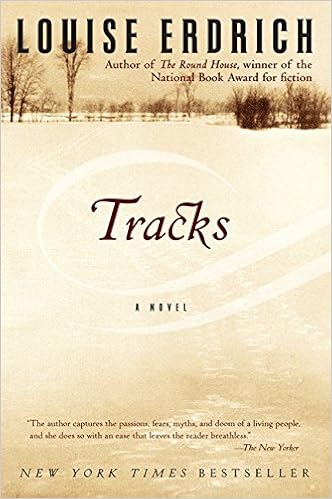
            The setting of Tracks is within a Ojibwe reservation in the early 1900’s. The story discloses the hardship of several members within the tribe. Narrated by the pure blooded self-assured chief elder Nanapush and the cowardly mixed blood Pauline, the story offers several different points of views on the gradual extermination of their culture.
            It is implied that early in his life Nanapush had a lot of choice in his life. A male member of the tribe Nanapush is a man who holds a lot of respect. His strong willed stubborn nature also allows to have more choice within his life. However, as the story goes on Nanapush’s choices disappears with the rest of his culture. While he still stubbornly keeps his own religion and much of his culture as the white men invade his culture he slowly to give in to more parts of his culture. For example, when his granddaughter Lulu is born Nanapush places his name on the records, this goes against many of his beliefs as throughout the novel Nanapush discloses that he believes that written language destroys a person identity. As his culture is taken over Nanapush slowly has to yield to the customs and traditions of this new culture.
            Throughout her life, Pauline seems to lack control of her own circumstances. Being of mixed blood Pauline constantly struggles to fit into one of her two cultures. Early in the story she reveals that she had a preference towards the white part of her identity. However, she still always feels like a freak of nature. Often considered to be a bit homely she is in a constant state of jealousy; her target of envy is generally a pure-blooded Ojibew named floor. Much of her actions are made from this emotion, and her envy as insecurity’s eventually snowball causing her to slowly lose her sanity. Because of the circumstances, she was born into Pauline had a very limited capacity for free will, and as she focused on these circumstances her situation just got a lot worse.
            

Tuesday, November 22, 2016

King Lear

            In some ways, the ideas of free will laid out in King Lear are similar ideas laid out in East of Eden. Like East of Eden most of the hindrances of free will come from family disputes. Also, like East of Eden a lot of the limits to free will come from parental favoritism. In East of Eden the parental favoritism comes from Cyrus’s preference of Adam over Charles, and then Aaron over Cal. In King Lear, the favoritism is between King Lear and his daughters Goneril, Reagan and Cordelia. King Lear seem to favor his youngest daughter Cordelia over the older two sisters. This favoritism causes the other two sisters to grow bitter over time. Their bitterness and jealously over their sister and kingdom is arguably the reason for their actions against their family and the kingdom. It was their childhood, and how they were raised that caused them to act against their kingdom. This an argument against free will. Unlike the other two sisters, Cordelia wasn’t subjected to the same negligent parenting and unlike her sisters she chose to live a life that was based on kindness. The way that their father treated them ultimately decided how the sisters chose to live their life.
            But like East of Eden parental favoritism isn’t the only thing that has the capacity to limit the free will of a person. Like East of Eden mental health is another thing that can limit the capacity of choice a person can have to make their own choices. Cathy of East of Eden, was limited by her psychopathy and King Lear is limited to and infliction similar to Alzheimer’s. Reflecting the state of his kingdom, Lear slowly loses his mind as it falls into chaos. He says senseless things and holds pseudo-trials for an invisible defendant. In this state, he has no capacity to make any choices in regards to his own well-being. Throughout most this story King Lear is at the mercy of the decisions made by his adviser Kent. Although Kent is a just and loyal servant and his choices are made on the benefit of the King, Lear has no say in where they go while fleeing from his daughters. His mental health ultimately takes away any capacity that he has to make any choices.

Sunday, November 13, 2016

East of Eden

            East of Eden is the perfect book to use to analyze my question. One of the largest themes throughout the novel is how much our parent’s impact us, especially when it comes to parental favoritism. Mirroring the story of Cain and Able, Cyrus favored his son Adam over his other son Charles. This sent Charles down a dark path, desperate for his love and consumed by envy Charles beats his brother to the edge of death with a baseball bat. Throughout his life Charles was unable to overcome the influence that Cyrus had on him. His insecurities always had more of an influence over him than his morality had over himself. Another thing that can limit the capacity of free will is mental illness. The perfect example for this is Cathy. Born with psychopathy Cathy does not have sense of morality. In fact, she has a point of view of the world that is like the witches of Macbeth “Fair is foul, and foul is fair”. She views the world with an almost animalistic perspective, giving her little to no choice in her actions. Most of the choices she made were based on either self-preservation or a desire to escape. Because of her disability her choices were not her own.

Wednesday, September 7, 2016

Oedipus Rex

The inevitability of fate is on of the largest themes in Sophecles Oedipus Rex. Then entire story is a lesson on how it is impossible to cheat fate. This was a reocurring theme in Greek Myth. The ancient greeks believed that the gods more specifically the Fates decided the life of a person. This of course meant that people have very little free will. Through dramatic irony Sophecles shows it is impossible to defy fate. 
After learning that he will kill his father and marry mother (whom he believes to be Merope and Polybus of Corinth) Oedipus attempts to avoid his fate by fleeing from Corinth to Thebes. What Oedipus didn't know was that the Merope and Polybus were not his birth parents. His parents were Jocasta and Laius the king and queen of Thebes who left Oedipus exposed on the hill to die as a baby, having learned of the prophecy themselves. As fate would have it Oedipus runs into his farher Laius on the road to Thebes and in a fight murders the man never knowing his relation to the man. He moves to Thebes and marrys the newly widowed Jocasta, completeing the prophecy.
Oedipus had abseloutly no free will in this story. Or rather no control of his fate. All of the choices he made led exactly to the prophecy that Apollo and the fates had set up for him. The greeks would argue that the choices that Oedipus makes were pre-destined as well, no matter what he would make the decisons thay he did

Tuesday, September 6, 2016

To what extent do we have free will?


For my big question this year I decided to ask my question on how much free will a person really has. At first I was going to phrase to "Do we have free will?" but after the discussion we had in class I decided that free will worked more as a spectrum than a simple yes or no answer. There are a lot of things that can effect how much say we have in the choices we make, and a lot of things that effect how we make these choices.
I did a project on this several years ago for my American Literature Honors class Sophomore year, and although I put in a good amount of thought into answering this question there is just so much more on this topic to explore. I had another website created, that was super-duper pretty but unfortunately it got blocked by the school the school fire wall so I was forced to use blogger instead (a case for free will being limited perhaps). 
Although this blog will be probably consist of majority literary references as it is for a literature class I do want to include opinions from outside sources. I already have a good collection of them on my other  blog and will eventually add that information over as well as add new sources that I discover throughout the year.
I'm looking forward to exploring this age old question. Hopefully the stories we read with enlighten me to new ways of looking at the idea of free will and hopefully reading these discussions will enlighten you on this topic as well.