In the 1969, science-fiction novel Slaughter-House Five, Kurt Vonnegut also
makes a compelling argument for hard-determinism. Told in an un-sequential
manner the story follows Billy Pilgrim a pessimistic war-vet as he lives his
life, and experiences an abduction from an extra-terrestrial race called the
Tralfalmadorians. Being “unstuck from time” Billy knows every event that is
going to happen to him and yet “Among the
things that Billy cannot change are the past, present, and future” (Vonnegut 62).
His time traveling capabilities allow Billy to see all the chains of cause
and effect that he will experience in his life, and they allow him to
understand that he has very little control over it. The Tralfalmadorians also
experience the universe in a similar way to Billy. Instead of seeing the
universe one moment at a time, the see every moment that has ever occupied that
space. As one Tralfalmadorians puts it "I am a Tralfalmadorians, seeing
all time as you might see a stretch of the Rocky Mountains. All time is all
time. It does not change. It does not lend itself to warnings or explanations.
It simply is. Take it moment by moment, and you will find that we are all, as
I've said before, bugs in amber." (Vonnegut 65-66). Without a linear notion of time one
cannot have the concept of free will. Although, they understand everything that
will happen these Tralfalmadorians know that they cannot do anything to change
the events that will happen. When Billy asks how the universe will end one of
the aliens explains that a pilot will blow it up attempting to test a new
engine for a space craft. Billy tells him that the pilot should just avoid
pushing the button to which the Tralfalmadorians replied “He always pressed it, and he always will. We always let him, and
always will. The moment is structured that way” (Vonnegut 117) The
Tralfalmadorians can see the entire picture of the chains of cause and effect,
they know that there is no way that they can change the events leading up to
this event. When we view our lives and choices linearly, it is a lot easier to
pretend that we have the capability to make choices. Looking at our lives
moment by moment makes it seem that the choices we make are our own. But if we
zoom out and look at the entirety of our lives we can see that each of these
choices were just a consequence of things that happened earlier. Because our
motivations, and therefore our choices are caught in this chain of cause and
effect we cannot say that they are free. Hard-determinism is the most accurate
philosophy regarding free-will because of it’s understanding of how the world
works. Like Billy we are being thrown around, trying to experience our lives in
a world that we cannot control.
Tuesday, May 9, 2017

Tuesday, April 4, 2017
The Invisible Man
Invisible Man
I’ve come
to understand that the ability to make decisions can be hindered by several
factors. The Invisible Man does a good job exploring how societal factors
impact our capability to make our own decisions.
The
Invisible Man as he is regarded as throughout the story has been described through
the story must follow different “rules” because he is a black man, in a time
and era in which racism was a common practice. He is severely limited in life
due to the fact that he is a black man. He does not have access to as many job opportunities,
in fact he is generally decided to be inferior to the white man in society.
Due to
the color of his skin the narrator constantly had to carry around the stereotypes
that society has placed him. Symbolized by a brief case that he could not get
rid of, The Invisible Man always had to live with the fact that he was a black
man. He could not get rid of the prejudice that the color of his skin applied
to him.
This prejudice
guided the choices that he made in life and the opportunities that he had. Like
all of us the prejudices that society applied to him helped shape the choices
that he had and the choices that he made. Because of the prejudice society has
for him his capacity to make choices (free will) has been limited.
Friday, February 17, 2017
The Stranger
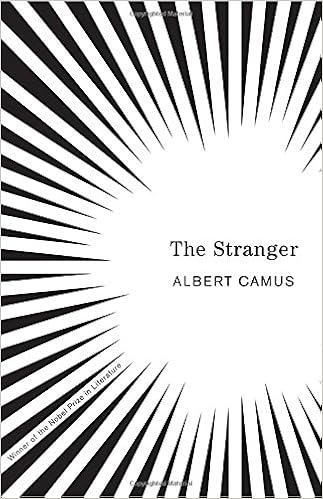 The Stranger like pretty much every other novel that we’ve
read this year applies quite well to my question of “To what extent we have
free will?”. Written with a existentialist philosophy, The Stranger following a
few days in the life and eventually the death of a French Algerian seemingly
apathetic man by the name of Meursault. Due to its basis in existentialism The
Stranger makes a strong argument towards free will only being applied in an
extremely limited extent.
The Stranger like pretty much every other novel that we’ve
read this year applies quite well to my question of “To what extent we have
free will?”. Written with a existentialist philosophy, The Stranger following a
few days in the life and eventually the death of a French Algerian seemingly
apathetic man by the name of Meursault. Due to its basis in existentialism The
Stranger makes a strong argument towards free will only being applied in an
extremely limited extent.
First off one of the basic pillars
of existentialism is that reason is impotent when dealing with human life, or
in other words human actions don’t always make logical sense. This is a clear
argument against the idea that people have a large inclination towards free
will. If a person can’t logically think through their action’s than they have a
limited amount of control over the actions that they take. In this novel Meursault
is a clear example of this. In the end of part one Meursault murders an Arabic
man. At first it seems like an accident, with Meursault accidentally pulling
the trigger through his coat jacket. But afterwards, under the glare of the
sun, Meursault pulls the trigger four more times. When asked about it Meursault
states that he doesn’t understand why he did it. It just felt right. Because
Meursault had no logical reasoning behind his decision his capacity toward free
will was limited.
Another pillar of Extentialism is the idea that we live in a chaotic world. While on one hand this may add to the idea of having free will as it implies that there is no supreme being controlling our actions on a day to day basis. However, it also means that we cannot control what happens to us. In the context of The Stranger while Meursault made the action that led him to his trial he cannot control what happens to him during the trial. He couldn’t control the jury, or the lawyers and he had no control over the outcome of his trial or how where the rest of his life would lead.
Another pillar of Extentialism is the idea that we live in a chaotic world. While on one hand this may add to the idea of having free will as it implies that there is no supreme being controlling our actions on a day to day basis. However, it also means that we cannot control what happens to us. In the context of The Stranger while Meursault made the action that led him to his trial he cannot control what happens to him during the trial. He couldn’t control the jury, or the lawyers and he had no control over the outcome of his trial or how where the rest of his life would lead.
Subscribe to:
Posts (Atom)