In the 1969, science-fiction novel Slaughter-House Five, Kurt Vonnegut also
makes a compelling argument for hard-determinism. Told in an un-sequential
manner the story follows Billy Pilgrim a pessimistic war-vet as he lives his
life, and experiences an abduction from an extra-terrestrial race called the
Tralfalmadorians. Being “unstuck from time” Billy knows every event that is
going to happen to him and yet “Among the
things that Billy cannot change are the past, present, and future” (Vonnegut 62).
His time traveling capabilities allow Billy to see all the chains of cause
and effect that he will experience in his life, and they allow him to
understand that he has very little control over it. The Tralfalmadorians also
experience the universe in a similar way to Billy. Instead of seeing the
universe one moment at a time, the see every moment that has ever occupied that
space. As one Tralfalmadorians puts it "I am a Tralfalmadorians, seeing
all time as you might see a stretch of the Rocky Mountains. All time is all
time. It does not change. It does not lend itself to warnings or explanations.
It simply is. Take it moment by moment, and you will find that we are all, as
I've said before, bugs in amber." (Vonnegut 65-66). Without a linear notion of time one
cannot have the concept of free will. Although, they understand everything that
will happen these Tralfalmadorians know that they cannot do anything to change
the events that will happen. When Billy asks how the universe will end one of
the aliens explains that a pilot will blow it up attempting to test a new
engine for a space craft. Billy tells him that the pilot should just avoid
pushing the button to which the Tralfalmadorians replied “He always pressed it, and he always will. We always let him, and
always will. The moment is structured that way” (Vonnegut 117) The
Tralfalmadorians can see the entire picture of the chains of cause and effect,
they know that there is no way that they can change the events leading up to
this event. When we view our lives and choices linearly, it is a lot easier to
pretend that we have the capability to make choices. Looking at our lives
moment by moment makes it seem that the choices we make are our own. But if we
zoom out and look at the entirety of our lives we can see that each of these
choices were just a consequence of things that happened earlier. Because our
motivations, and therefore our choices are caught in this chain of cause and
effect we cannot say that they are free. Hard-determinism is the most accurate
philosophy regarding free-will because of it’s understanding of how the world
works. Like Billy we are being thrown around, trying to experience our lives in
a world that we cannot control.
Tuesday, May 9, 2017

Tuesday, April 4, 2017
The Invisible Man
Invisible Man
I’ve come
to understand that the ability to make decisions can be hindered by several
factors. The Invisible Man does a good job exploring how societal factors
impact our capability to make our own decisions.
The
Invisible Man as he is regarded as throughout the story has been described through
the story must follow different “rules” because he is a black man, in a time
and era in which racism was a common practice. He is severely limited in life
due to the fact that he is a black man. He does not have access to as many job opportunities,
in fact he is generally decided to be inferior to the white man in society.
Due to
the color of his skin the narrator constantly had to carry around the stereotypes
that society has placed him. Symbolized by a brief case that he could not get
rid of, The Invisible Man always had to live with the fact that he was a black
man. He could not get rid of the prejudice that the color of his skin applied
to him.
This prejudice
guided the choices that he made in life and the opportunities that he had. Like
all of us the prejudices that society applied to him helped shape the choices
that he had and the choices that he made. Because of the prejudice society has
for him his capacity to make choices (free will) has been limited.
Friday, February 17, 2017
The Stranger
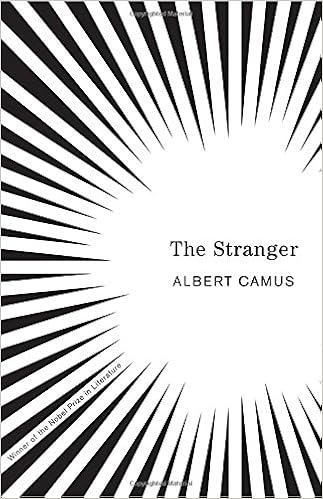 The Stranger like pretty much every other novel that we’ve
read this year applies quite well to my question of “To what extent we have
free will?”. Written with a existentialist philosophy, The Stranger following a
few days in the life and eventually the death of a French Algerian seemingly
apathetic man by the name of Meursault. Due to its basis in existentialism The
Stranger makes a strong argument towards free will only being applied in an
extremely limited extent.
The Stranger like pretty much every other novel that we’ve
read this year applies quite well to my question of “To what extent we have
free will?”. Written with a existentialist philosophy, The Stranger following a
few days in the life and eventually the death of a French Algerian seemingly
apathetic man by the name of Meursault. Due to its basis in existentialism The
Stranger makes a strong argument towards free will only being applied in an
extremely limited extent.
First off one of the basic pillars
of existentialism is that reason is impotent when dealing with human life, or
in other words human actions don’t always make logical sense. This is a clear
argument against the idea that people have a large inclination towards free
will. If a person can’t logically think through their action’s than they have a
limited amount of control over the actions that they take. In this novel Meursault
is a clear example of this. In the end of part one Meursault murders an Arabic
man. At first it seems like an accident, with Meursault accidentally pulling
the trigger through his coat jacket. But afterwards, under the glare of the
sun, Meursault pulls the trigger four more times. When asked about it Meursault
states that he doesn’t understand why he did it. It just felt right. Because
Meursault had no logical reasoning behind his decision his capacity toward free
will was limited.
Another pillar of Extentialism is the idea that we live in a chaotic world. While on one hand this may add to the idea of having free will as it implies that there is no supreme being controlling our actions on a day to day basis. However, it also means that we cannot control what happens to us. In the context of The Stranger while Meursault made the action that led him to his trial he cannot control what happens to him during the trial. He couldn’t control the jury, or the lawyers and he had no control over the outcome of his trial or how where the rest of his life would lead.
Another pillar of Extentialism is the idea that we live in a chaotic world. While on one hand this may add to the idea of having free will as it implies that there is no supreme being controlling our actions on a day to day basis. However, it also means that we cannot control what happens to us. In the context of The Stranger while Meursault made the action that led him to his trial he cannot control what happens to him during the trial. He couldn’t control the jury, or the lawyers and he had no control over the outcome of his trial or how where the rest of his life would lead.
Friday, December 16, 2016
Tracks
Tracks
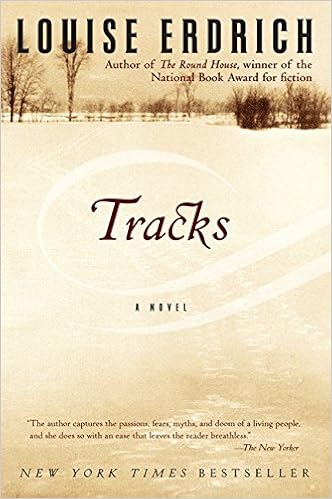
takes a different look at my big question. Most of the other books that I have
read focus on how familial conditions impact our capacity towards free will.
While Tracks has some aspects of this, it focuses more on how the circumstances
of our birth impacts our ability to make choices.
 The
setting of Tracks is within a Ojibwe reservation in the early 1900’s. The story
discloses the hardship of several members within the tribe. Narrated by the
pure blooded self-assured chief elder Nanapush and the cowardly mixed blood
Pauline, the story offers several different points of views on the gradual
extermination of their culture.
The
setting of Tracks is within a Ojibwe reservation in the early 1900’s. The story
discloses the hardship of several members within the tribe. Narrated by the
pure blooded self-assured chief elder Nanapush and the cowardly mixed blood
Pauline, the story offers several different points of views on the gradual
extermination of their culture.
It is
implied that early in his life Nanapush had a lot of choice in his life. A male
member of the tribe Nanapush is a man who holds a lot of respect. His strong
willed stubborn nature also allows to have more choice within his life. However,
as the story goes on Nanapush’s choices disappears with the rest of his
culture. While he still stubbornly keeps his own religion and much of his
culture as the white men invade his culture he slowly to give in to more parts
of his culture. For example, when his granddaughter Lulu is born Nanapush
places his name on the records, this goes against many of his beliefs as throughout
the novel Nanapush discloses that he believes that written language destroys a
person identity. As his culture is taken over Nanapush slowly has to yield to
the customs and traditions of this new culture.
Throughout
her life, Pauline seems to lack control of her own circumstances. Being of
mixed blood Pauline constantly struggles to fit into one of her two cultures. Early
in the story she reveals that she had a preference towards the white part of
her identity. However, she still always feels like a freak of nature. Often
considered to be a bit homely she is in a constant state of jealousy; her
target of envy is generally a pure-blooded Ojibew named floor. Much of her
actions are made from this emotion, and her envy as insecurity’s eventually
snowball causing her to slowly lose her sanity. Because of the circumstances,
she was born into Pauline had a very limited capacity for free will, and as she
focused on these circumstances her situation just got a lot worse.
Tuesday, November 22, 2016
King Lear
But like
East of Eden parental favoritism isn’t the only thing that has the capacity to
limit the free will of a person. Like East of Eden mental health is another
thing that can limit the capacity of choice a person can have to make their own
choices. Cathy of East of Eden, was limited by her psychopathy and King Lear is
limited to and infliction similar to Alzheimer’s. Reflecting the state of his
kingdom, Lear slowly loses his mind as it falls into chaos. He says senseless
things and holds pseudo-trials for an invisible defendant. In this state, he
has no capacity to make any choices in regards to his own well-being. Throughout
most this story King Lear is at the mercy of the decisions made by his adviser Kent.
Although Kent is a just and loyal servant and his choices are made on the benefit
of the King, Lear has no say in where they go while fleeing from his daughters.
His mental health ultimately takes away any capacity that he has to make any
choices.
Sunday, November 13, 2016
East of Eden
 East
of Eden is the perfect book to use to analyze my question. One of the largest
themes throughout the novel is how much our parent’s impact us, especially when
it comes to parental favoritism. Mirroring the story of Cain and Able, Cyrus
favored his son Adam over his other son Charles. This sent Charles down a dark
path, desperate for his love and consumed by envy Charles beats his brother to
the edge of death with a baseball bat. Throughout his life Charles was unable
to overcome the influence that Cyrus had on him. His insecurities always had
more of an influence over him than his morality had over himself. Another thing
that can limit the capacity of free will is mental illness. The perfect example
for this is Cathy. Born with psychopathy Cathy does not have sense of morality.
In fact, she has a point of view of the world that is like the witches of
Macbeth “Fair is foul, and foul is fair”. She views the world with an almost
animalistic perspective, giving her little to no choice in her actions. Most of
the choices she made were based on either self-preservation or a desire to
escape. Because of her disability her choices were not her own.
East
of Eden is the perfect book to use to analyze my question. One of the largest
themes throughout the novel is how much our parent’s impact us, especially when
it comes to parental favoritism. Mirroring the story of Cain and Able, Cyrus
favored his son Adam over his other son Charles. This sent Charles down a dark
path, desperate for his love and consumed by envy Charles beats his brother to
the edge of death with a baseball bat. Throughout his life Charles was unable
to overcome the influence that Cyrus had on him. His insecurities always had
more of an influence over him than his morality had over himself. Another thing
that can limit the capacity of free will is mental illness. The perfect example
for this is Cathy. Born with psychopathy Cathy does not have sense of morality.
In fact, she has a point of view of the world that is like the witches of
Macbeth “Fair is foul, and foul is fair”. She views the world with an almost
animalistic perspective, giving her little to no choice in her actions. Most of
the choices she made were based on either self-preservation or a desire to
escape. Because of her disability her choices were not her own.Wednesday, September 7, 2016
Oedipus Rex
 The inevitability of fate is on of the largest themes in Sophecles Oedipus Rex. Then entire story is a lesson on how it is impossible to cheat fate. This was a reocurring theme in Greek Myth. The ancient greeks believed that the gods more specifically the Fates decided the life of a person. This of course meant that people have very little free will. Through dramatic irony Sophecles shows it is impossible to defy fate.
After learning that he will kill his father and marry mother (whom he believes to be Merope and Polybus of Corinth) Oedipus attempts to avoid his fate by fleeing from Corinth to Thebes. What Oedipus didn't know was that the Merope and Polybus were not his birth parents. His parents were Jocasta and Laius the king and queen of Thebes who left Oedipus exposed on the hill to die as a baby, having learned of the prophecy themselves. As fate would have it Oedipus runs into his farher Laius on the road to Thebes and in a fight murders the man never knowing his relation to the man. He moves to Thebes and marrys the newly widowed Jocasta, completeing the prophecy.
Oedipus had abseloutly no free will in this story. Or rather no control of his fate. All of the choices he made led exactly to the prophecy that Apollo and the fates had set up for him. The greeks would argue that the choices that Oedipus makes were pre-destined as well, no matter what he would make the decisons thay he did
Oedipus had abseloutly no free will in this story. Or rather no control of his fate. All of the choices he made led exactly to the prophecy that Apollo and the fates had set up for him. The greeks would argue that the choices that Oedipus makes were pre-destined as well, no matter what he would make the decisons thay he did
Subscribe to:
Posts (Atom)